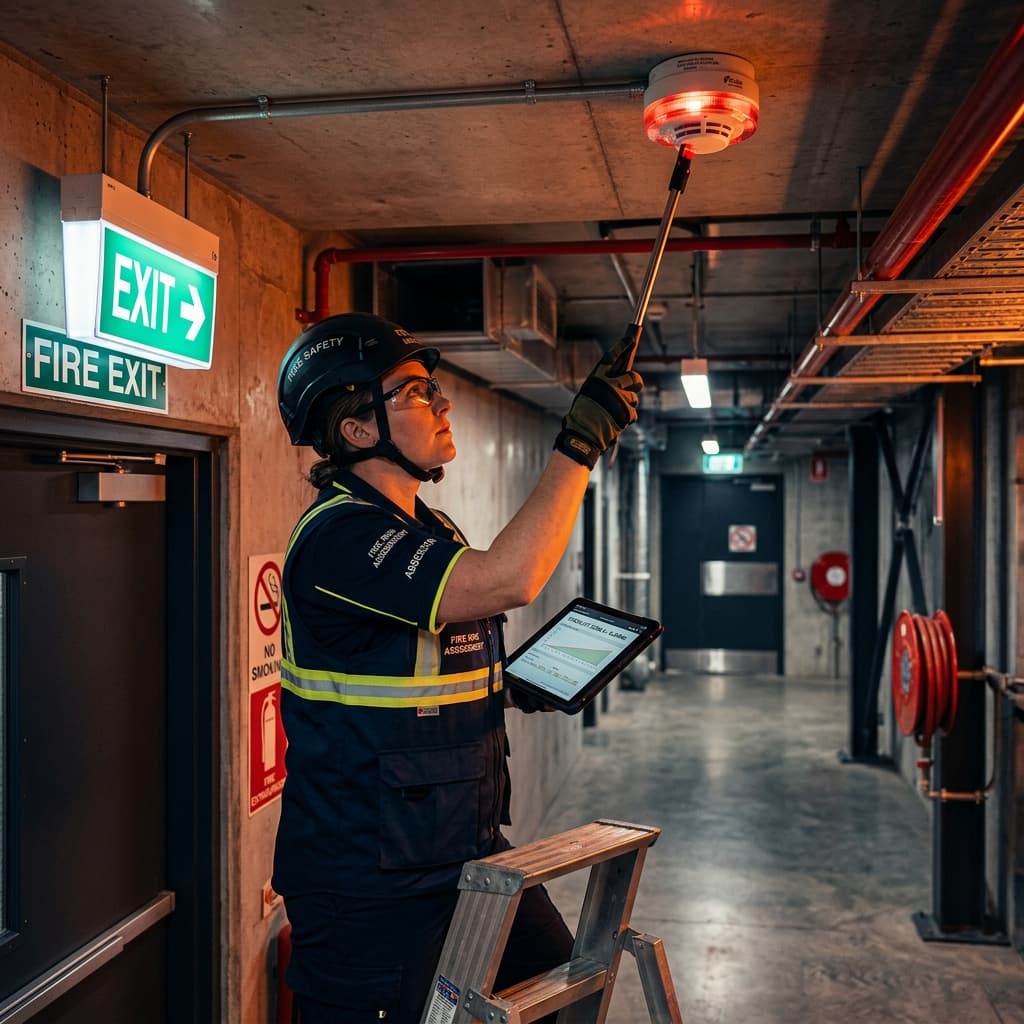
Types 1, 2, 3 & 4 Fire Risk Assessments Explained
Understand the statutory scope, intrusive destructive sampling, flat access, and commercial complexity levels under PAS 79-1 & PAS 79-2.
Assessment Types Define Scope — Not Quality
In the UK, Fire Risk Assessments for residential blocks of flats are categorised from Type 1 to Type 4 in accordance with government-endorsed guidance and PAS 79-2:2020. This classification defines two fundamental scope decisions:
Whether the survey is restricted to communal landlord areas only (Types 1 & 2) or extends inside demised individual flats (Types 3 & 4).
Whether the survey is purely visual / non-destructive (Types 1 & 3) or involves physical intrusive opening up of ceiling voids and service risers (Types 2 & 4).
Purpose-Built Blocks of Flats (Types 1–4)
Compare the scope, flat access, and destructive requirements for blocks of flats and residential developments.
Type 1
Most Common Starting PointVisual inspection of communal corridors, escape stairs, risers, plant rooms, and a sample of flat entrance fire doors (external check).
Type 2
Destructive SamplingType 1 scope plus opening up sample areas of suspended ceilings, service risers, and compartment penetration fire-stopping to examine hidden construction.
Type 3
Flats SampledType 1 scope plus non-intrusive internal visual inspection inside a representative sample of flats (front entrance doors checked both sides, internal smoke alarms, and dividing walls).
Type 4
Broadest ScopeComprehensive investigation combining flat access with destructive opening of ceiling voids, riser shafts, and separating walls/floors across communal areas and sample flats.
Commercial Fire Risk Assessment Levels (1–4)
For non-domestic premises, offices, retail, hospitality, schools, care homes, and industrial plants.
Designed for small, single-storey retail shops, small single-floor offices (<300m²), dry storage units, and surgeries with simple single-direction escape routes.
- ✓ Core ignition & combustible evaluation
- ✓ Single-direction escape pathway validation
- ✓ Portable extinguishers & basic signage check
- ✓ Basic fire safety logbook review
Our most popular assessment for multi-storey offices, licensed HMOs, retail with basements, restaurants, small factories, and clinics.
- ✓ Full Level 1 scope
- ✓ BS 8214 fire door integrity checks
- ✓ Category L2/L3/L4 alarm system review
- ✓ BS 5266 emergency escape lighting test review
- ✓ Staff training & evacuation plan audit
For larger multi-storey commercial complexes, care homes, hospitals, schools, universities, and high-occupancy assembly venues.
- ✓ Full Level 2 scope
- ✓ Phased & zoned evacuation strategies
- ✓ Smoke ventilation & AOV systems (BS 7346)
- ✓ BS EN 12845 sprinkler / suppression review
- ✓ DSEAR dangerous substances & PEEPs audit
Comprehensive assessment for High-Rise Residential Buildings (>18m / 7+ storeys), chemical/industrial facilities, historic listed assets, or complex engineered fire strategies.
- ✓ Full Level 3 scope
- ✓ Building Safety Act 2022 Safety Case integration
- ✓ PAS 9980 external wall & cladding reference appraisal
- ✓ Fire-fighting shafts & firefighter lift verification
- ✓ Cause-and-effect matrix compliance audit
Powered by Safeguard's Modern Compliance Software
We don't just supply static PDF reports. Every client receives complimentary access to their dedicated Safeguard Client Portal with interactive action plans, digital fire door registers, and real-time compliance health scoring.
Compliance Assurance Metrics
Common Questions About FRA Types & Levels
Is a Type 4 Fire Risk Assessment always better than a Type 1?
No. The type number describes the physical scope of inspection, not the quality of the report. Type 4 involves disruptive destructive sampling and flat access which is only necessary when there is strong evidence of hidden structural defects. For the vast majority of purpose-built residential blocks, a Type 1 assessment is the legally recommended starting baseline.
Do Types 1 to 4 apply to commercial offices, shops, or warehouses?
No. The Type 1–4 classification was developed specifically for purpose-built blocks of flats under PAS 79-2. Commercial, industrial, and retail premises are categorised under Safeguard's Complexity Levels 1 to 4 (PAS 79-1), which evaluate occupancy loads, height, processes, and fire systems.
Does a Type 1 FRA inspect flat entrance fire doors?
Yes. Under the Fire Safety Act 2021 and Fire Safety (England) Regulations 2022, flat entrance doors are part of the common parts fire protection. A Type 1 FRA examines a representative sample of flat entrance doors from the communal corridor side.
How often should a Fire Risk Assessment be reviewed in the UK?
Under the Regulatory Reform (Fire Safety) Order 2005, an FRA must be kept up to date. Standard industry practice recommends reviewing commercial and residential FRAs annually (every 12 months), or immediately if there are significant alterations to the layout, building use, occupancy, or following a fire incident.
Not sure which Fire Risk Assessment level or type your building requires?
Speak to a Competent Fire Risk Assessor →